On this page
You have already done it in your head, sissy. A hundred times. You are dressed, you are ready, and instead of going out you walk to the window and stand just behind the curtain, looking at a street you do not go down. Then you undress, and you tell yourself it was never really the plan.
I did that for two years. Two years of being perfect in a bedroom and terrified of a corridor. And what finally moved me was not courage, because I did not have any. It was Mistress, in her coat, holding the car keys, telling me we were only going to drive. Nothing more. Just drive.
So let me tell you the part nobody tells you, and then let me give you the ladder I actually climbed. The world outside is far less interested in you than the one inside your head is. That is not a comfort I am offering you. It is the finding.
Nobody Is Looking at You
Here is the thing I got wrong for two years, and it cost me two years, so I want you to have it in the first minute instead.
You imagine a street full of people scanning faces for a man in a dress. That street does not exist. What exists is a street full of people looking at their phones, worrying about being late, thinking about a message they should not have sent. The average stranger gives you somewhere under a second of attention, most of it peripheral, and spends it deciding one thing only: are you a person walking, or a person about to walk into me. Then they are gone, and so are you.
The fear is not irrational, it is just misdirected. It feels like a fear of being seen. It is really a fear of being studied, and studying is exactly what strangers do not do. The people who studied you were the ones who knew you, and none of them are in the next town at nine on a Tuesday evening.
I want to be honest about the other half, because I am not going to sell you a fairy tale. Sometimes someone clocks you. It happens. It happened to me outside a supermarket, a young man who looked twice, then a third time, then went back to his conversation and forgot about me before I had reached the door. That is what being clocked mostly is. Not a scene. Not a confrontation. Just somebody noticing something and finding it much less interesting than you do.
The first time I stood on a pavement in a dress, the world did the most extraordinary thing. It carried on.
And I need to say this plainly, because a lot of us waste years on it: passing is not the entrance fee. Crossdressing is wearing the clothes, nothing more and nothing less, and you do not owe a stranger a flawless illusion in exchange for existing outdoors while you do it. Plenty of women are tall. Plenty have big hands, a heavy jaw, a low voice on the phone. The goal of a first outing is not to fool anybody. It is to be unremarkable enough to be left alone, which is a far lower bar and entirely within reach of a beginner with a coat and a plan.
The Ladder: Nine Steps From Your Bedroom to the Street
Nobody goes from the mirror to the high street. Everyone who is out there now climbed something like this, one rung at a time, and most of us stalled somewhere in the middle for months. That is not failure, that is the shape of it.
Do not skip rungs to prove something. Repeat any rung until it is boring, because boring is the whole point. Boring is what you are manufacturing.
- Dressed, at your own front door, hand on the handle. You do not open it. You stand there fully dressed with your heart going, and you let your body learn that the handle is not a trap. Two minutes. Repeat on another evening.
- The doorstep, the garden, the balcony. Ten seconds of night air on your legs. This is the rung where most of us discover that the outside temperature is a real consideration and the outside audience is not.
- The car, parked, engine off. Dressed, in the driver’s seat, in the dark. Sit for five minutes. Look at people walking past who do not turn their heads.
- A drive with no destination. Late, unhurried, nobody waiting for you anywhere. You are outdoors, in public, in a dress. It counts. It absolutely counts.
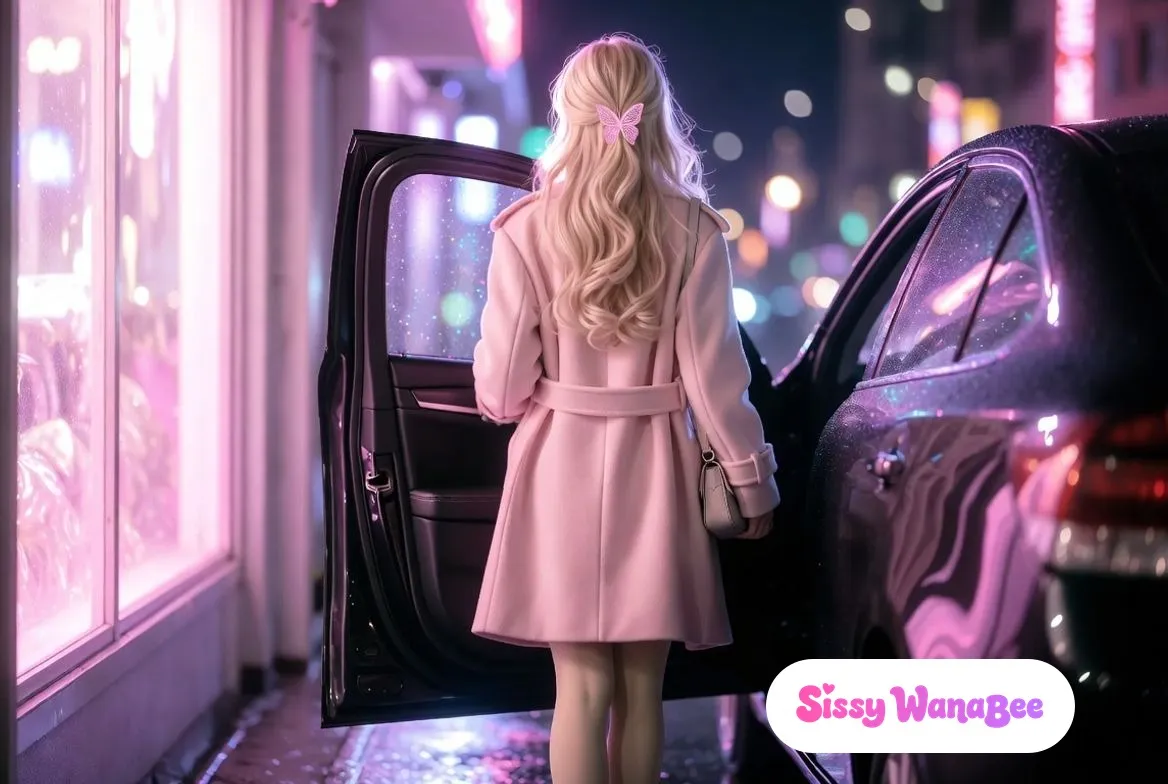
- A car park at night, standing outside the car. Feet on tarmac, door unlocked behind you. This was the rung that undid me. Standing up outside a car in heels is the moment your body understands that this is happening in the real world.
- A drive-through, or a petrol station at a quiet hour. Your first transaction. A voice, a card, four seconds of eye contact. Then it is done and nothing has happened.
- A big anonymous shop, late. A supermarket at ten at night, a twenty-four hour place, a retail park. Wide aisles, tired staff, nobody local. Buy one thing you actually need so you have a reason to be there that your own head accepts.
- A quiet café, park, or cinema in another town. The first time you sit down in public. Sitting is different from walking, because walking has an alibi and sitting does not. Take a book or a phone. Stay twenty minutes.
- A daytime street where nobody knows you. The last rung, and it will not feel like a summit. It will feel like walking down a street, which is the strangest and best part.
Notice what the ladder is actually built out of: darkness first, then distance, then anonymity, and only at the very end, daylight. And notice that six of the nine rungs need nobody to speak to you at all.
What to Wear the First Time
The instinct is to dress the way you dress in the bedroom, because that is where you learned to be her and that is where she looks glorious. Please do not. The bedroom wardrobe is designed to be looked at. The going out wardrobe is designed to be skipped over, and it is a genuinely different craft.
Look at what women your age actually wear on a normal Tuesday in your town. Whatever that is, wear a slightly duller version of it.
Skip the perfume you love, it is stronger than you think in a small space. Skip the nails if you are going somewhere you must show a card, or do not, but decide beforehand so it is not a surprise in the moment. And a soft face beats a full one at night, because streetlights are unkind to heavy makeup and kind to almost everything else. The beginner makeup routine is more than enough for a first outing.
The Going Out Kit
I keep this in the bag every single time, five years in. It is not a fear list, it is the opposite: it is what lets me stop running scenarios.
Pack it once, leave it packed. A bag that lives ready is a bag that removes one more reason to not go.
Safety, Honestly
I would rather be the sissy who told you than the one who left it out to keep the tone light. Almost nothing happens to almost everybody. But the risk is not zero, it is not evenly spread, and the ways to reduce it are boring and effective.
One more, and it is the practical one people forget: know the law and the culture where you actually live. In most of the world nothing about a man in a dress is illegal, and in some places it is genuinely unsafe. That is not a reason to stay in your bedroom forever, but it is a reason to choose your first place with your eyes open, and to plan around the town you are in rather than the town you read about online. If the law where you are is actually against you, read our guide to staying private before you plan any of this. It covers the countries where this is criminalised, and what changes when it is.
And if you share a life with someone, do not do this behind her back. Telling your partner is its own hard conversation, but going out is the point where secrecy stops being a private matter and starts being a risk you have put on both of you.
The First Ten Minutes
Here is what actually happens in the body, so you can recognise it instead of being ambushed by it.
The first minute is loud. Your heart is somewhere near your ears, your hands do not know where to be, and you are convinced you are walking wrong. You are not walking wrong. You are walking exactly like someone thinking about walking.
Around minute three, something reliable happens. Somebody passes you and nothing occurs. Then another. Then a woman glances at your coat, or your bag, or nothing at all, and looks away. And your nervous system, which had prepared an enormous and detailed catastrophe, sits there holding it with nowhere to put it. There is a strange flatness in that moment. Some sissies even feel disappointed, and if you do, you are not broken. You had braced for a hurricane and got weather.
By minute ten you are, unbelievably, a little bored. That is the prize. Not triumph, not euphoria. Boredom. The first time being out stops being an event and starts being a Tuesday is the moment the practice actually changed you, and you will barely notice it happening.
The mechanics that carry you through those ten minutes are small. Walk with a destination, even an invented one, because a body with somewhere to go reads as ordinary and a body hovering does not. Keep your hands occupied, a bag strap or a phone. Look at the middle distance, not at faces and not at the ground. And if your voice is going to be needed, keep it short and low in volume rather than high in pitch, which is the mistake I made for a year. Quiet reads as feminine long before pitch does, and it needs no voice training at all to manage.
When It Goes Wrong
Sometimes there is a look that lasts too long. Once in a while, a comment. Very rarely, a group of idiots. Have the answer decided in advance so you are not composing it while adrenaline is running.
The answer is: you leave. Not dramatically. You do not respond, you do not correct anybody, you do not defend your right to exist to somebody who is not going to be persuaded on a pavement at night. You turn, you walk toward light and people and staff, and you get in the car or into a shop. Every single time. Your dignity is not on the line out there. Only your safety is, and the exit is always the right move.
If it happens, the outing was still not a failure. Mine was not. I sat in the car afterwards with my hands shaking and my mascara suffering, and Mistress did not say anything clever. She put her hand on the back of my neck, the way she does, and let me be exactly as small as I felt for as long as I needed. Then we drove home and I went out again eleven days later, in a different town, in flat shoes.
Coming Home, and the Drop
Nobody warns you about the hours after, so I will.
You come home enormous. Then, sometimes that night and sometimes the next afternoon, the floor goes. It is a heavy, teary, hollow feeling, and it can arrive after a good outing, which is why it blindsides people. The body spent an evening on high alert, the hormones that carried you have to leave, and while they are leaving everything feels like evidence that you did something shameful. It is not evidence. It is chemistry with an opinion.
Plan for it the way you would plan for anything else on this list. Do not undress and go straight to bed alone with your phone. Eat something. Get warm. Put on the softest thing you own and stay her for another half hour instead of scrubbing her off at speed, because scrubbing her off at speed teaches your body that she was a mistake to be erased. If someone knows, let them hold you. If nobody knows yet, write it down, even three lines, so that tomorrow you have your own account and not the version your fear will offer you.
The One Thing I Would Ask of You
Not the street. Not tonight.
Tonight, dress completely, the way you would if you were going. Coat on, bag on your shoulder, keys in your hand. Then stand at your own front door with your hand on the handle for two full minutes, and do not open it. Feel the whole thing your body does. Then put everything away.
You are not allowed to skip ahead to the rung that flatters you. You take that one first, and you take it exactly as small as I have written it. That is not a suggestion, sissy. That is the method. Every one of us who is out there now stood behind that door with her hand on the handle, some of us for years. The difference between her and you is not courage. It is that she stood there on purpose, and she is going to stand there again next week.
Good girl. Now go and get dressed.
Frequently Asked Questions
Where should I go the first time I crossdress in public?
Somewhere dark, anonymous, and low-traffic, in a town where nobody knows you. A car park at night, a drive-through, a petrol station at a quiet hour, or a large supermarket late in the evening. Pick a place with a legitimate reason to be there, wide space, and an easy exit, and keep your own neighbourhood for much later.
Do I need to pass to go out in public?
No. Passing is not the entrance fee. The realistic goal of a first outing is to be unremarkable enough to be left alone, which is a far lower bar. A plain outfit, a coat, calm body language and an ordinary destination do more for that than any amount of facial feminisation. Most strangers give you under a second of attention and are not studying you.
What should I wear the first time I go out?
Something duller than you want to wear. A closing coat, a plain dark dress or top and jeans at mid-length, flats or a low block heel, and a shoulder bag. Wear a wig you have already worn indoors for a full evening so you know it does not move. Keep makeup soft rather than full, especially at night.
Is it safe to go out crossdressed?
For most people, most of the time, yes, but the risk is not zero and it is not evenly spread. Reduce it the boring ways: stay sober, avoid drunk crowds and bar strips at closing time, never let a stranger move you somewhere quieter, carry ID and a charged phone, tell one trusted person where you are, and leave the moment your instinct says to. Know the law and the culture of the place you actually live in.
What do I do if someone clocks me or says something?
You leave, calmly and immediately. Do not respond, do not explain yourself, and do not try to win. Walk toward light, people and staff, and get into a shop or your car. Being clocked is usually nothing more than a stranger looking twice and losing interest, but on the rare occasion it becomes a comment, the exit is always the correct move and it is not a defeat.
Why do I feel awful the day after a good outing?
That is the drop, and it is extremely common. Your body spent the evening on high alert, and when those hormones leave, the hollow feeling that follows can arrive even after an outing that went beautifully. Plan for it: eat, get warm, stay dressed a little longer rather than scrubbing her off, and let someone hold you if someone knows. It passes, and it is not a verdict on what you did.
Should I tell my partner before I go out in public?
Yes. Dressing at home is a private matter, but going out makes it a shared risk, and finding out afterwards is far harder on a partner than being told beforehand. If you have not had that conversation yet, have it first. Our guide to telling your partner walks through when, how, and the words to use.